Hypathia
From ancient Greek ‘Υπατια: highest, supreme.
Hypathia is the combination of simplified versions of Diomira and Irene. For future or hypothetical detectors, the energy plane electronics is not necessarily defined. In order to produce RWFs, we apply a generic and simplified model for the electronics to the TWFs produced by Buffy (full simulation) or Detsim (fast simulation). These effects are:
Gaussian noise for the PMT baseline (not really, but it should)
Charge fluctuations for photoelectron signals of PMTs
Noise sampled from PDFs for SiPMs
The RWFs produced here are not stored persistently, but rather fed into the peak search algorithm. This is equivalent to Irene, without the first step of deconvolution of the effects of the energy plane electronics. A detailed description of this procedure can be found in Irene. The final product are PMaps.
Input
/Run/events
/Run/runInfo
/RD/pmtrd
/RD/sipmrd
Output
Same as Irene:
/PMAPS/S1: the sliced PMT-summed waveform for each S1 peak. 4 columns: event number, peak number, time (\(\mu\)s) and amplitude (pes)
/PMAPS/S1Pmt: the sliced individual PMT waveforms for each S1 peak. 4 columns: event number, peak number, pmt id and amplitude (pes)
/PMAPS/S2: the sliced PMT-summed waveform for each S2 peak. 4 columns: event number, peak number, time (\(\mu\)s) and amplitude (pes)
/PMAPS/S2Pmt: the sliced individual PMT waveforms for each S2 peak. 4 columns: event number, peak number, pmt id and amplitude (pes)
/PMAPS/S2Si: the sliced individual SiPM waveforms for each S2 peak. 4 columns: event number, peak number, sipm id and amplitude (pes)
/Filters/empty_pmap: flag for whether an event passed the empty pmap filter
/Filters/s12_indices: flag for whether an event passed the s12 indices filter
Config
Besides the Common arguments to every city, Hypathia shares most of its parameters with Irene. The only exceptions are n_baseline, n_mau, and thr_mau. Moreover, the city has the following arguments:
Parameter |
Type |
Description |
|---|---|---|
|
|
Threshold for SiPM noise suppression in pes. |
|
|
Number of samples to keep before and after samples passing the zero-suppression filter for SiPMs. |
|
|
Rebin factor to apply to PMT waveforms to match DAQ sampling. |
|
|
Standard deviation in pes of the 1 pe peak in the Single PhohoElectron (SPE) spectrum. |
|
|
Threshold for individual SiPM samples. Can be absolute (pes) or relative (unitless), depending on |
|
|
Thresholding mode for individual SiPM samples. |
|
|
Lower/upper limits to the width of S1/S2 signals expressed in number of samples. |
|
|
Lower/upper limits of the search window for S1/S2 signals. |
|
|
Rebin factor for S1/S2 signals. Rarely changed. 1 for S1 and 40 for S2 signals. |
|
|
Allowed range of signal fluctuations below threshold for peak merging expressed in number of samples. |
|
|
Threshold applied to the PMT-summed waveform in order to find S1/S2 peaks. |
|
|
Threshold applied to the time-integrated signal of each SiPM to discard SiPMs with only dark counts. |
|
|
Sampling period of PMTs. Should be removed. |
|
|
Sampling period of SiPMs. Should be removed. |
Workflow
Hypathia performs a number of data transformations in order to obtain a PMap. These operations can be grouped in three main tasks, performed in the following order:
Simulation of PMT waveforms
The TWFs produced with MC simulations (either full + Buffy or fast + Detsim) are not necessarily sampled at the same period as the DAQ. Thus, the first step is to ensure that they are sampled at the same rate. This is controlled by the parameter pmt_wfs_rebin. Waveforms sampled with a period \(p\) are resampled with a period pmt_wfs_rebin \(\cdot p\). This operation can only be performed for pmt_wfs_rebin \(\geq 1\). For instance, if the MC simulation is performed with a binning of 1 ns, we need to set pmt_wfs_rebin to 25 to obtain waveforms sampled at 25 ns.
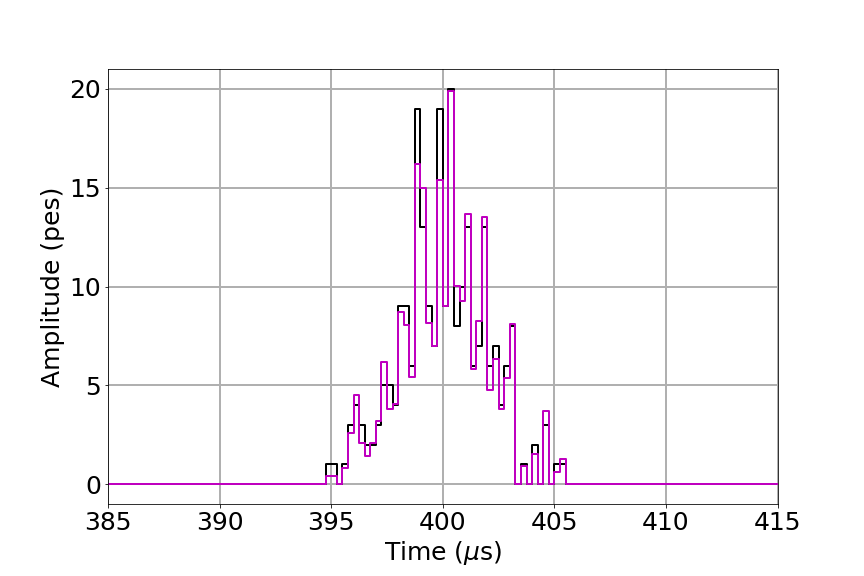
The next step is to simulate the fluctuations on the PMT response for photoelectrons. For a time bin with charge \(q\) the resulting charge comes from sampling a gaussian with \(\mu = q\) and \(\sigma = \sqrt{q}\ \cdot\) pmt_pe_rms. The resulting charge is clipped at 0 to avoid unphysical signals. The following image shows a (fake) PMT waveform with and without charge fluctuation. The algorithm is applied only to non-empty bins.
Simulation of SiPM waveforms
SiPM waveforms are always sampled at 1 \(\mu s\) in simulations [1] and therefore do not need to be resampled. These waveforms are processed to have a charge fluctuation analogous to the one described for PMTs above. In this case the rms parameter is taken from the measured values stored in the database (through the detector_db and run_number parameters). Then, noise is added to the waveforms by sampling the individual noise distribution of each SiPM, also stored in the database.
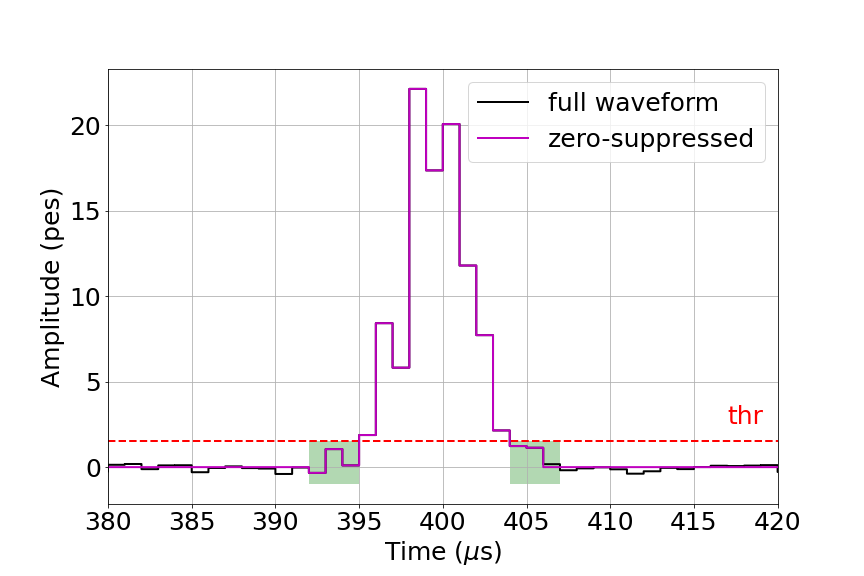
Finally, a zero suppression algorithm is applied to mimic the DAQ bahaviour. The samples of the SiPM waveforms with amplitude below sipm_noise_cut are set to zero. However, in the vecinity of a sample that survives the cut the waveform is not zero suppresed. This is controlled by the parameter filter_padding, which is the number of samples preserved before and after a sample that survives the zero suppression cut. This is exemplified in the following image. The time bins with charge above the threshold are unmodified, while those below it are set to 0, with the exception of those falling in the green region.
Computation of PMaps
This procedure is identical to that performed by Irene. For more information read the sections Baseline subtraction of SiPM waveforms, Waveform calibration and Peak finding and matching of PMT and SiPM signals in the Irene documentation.